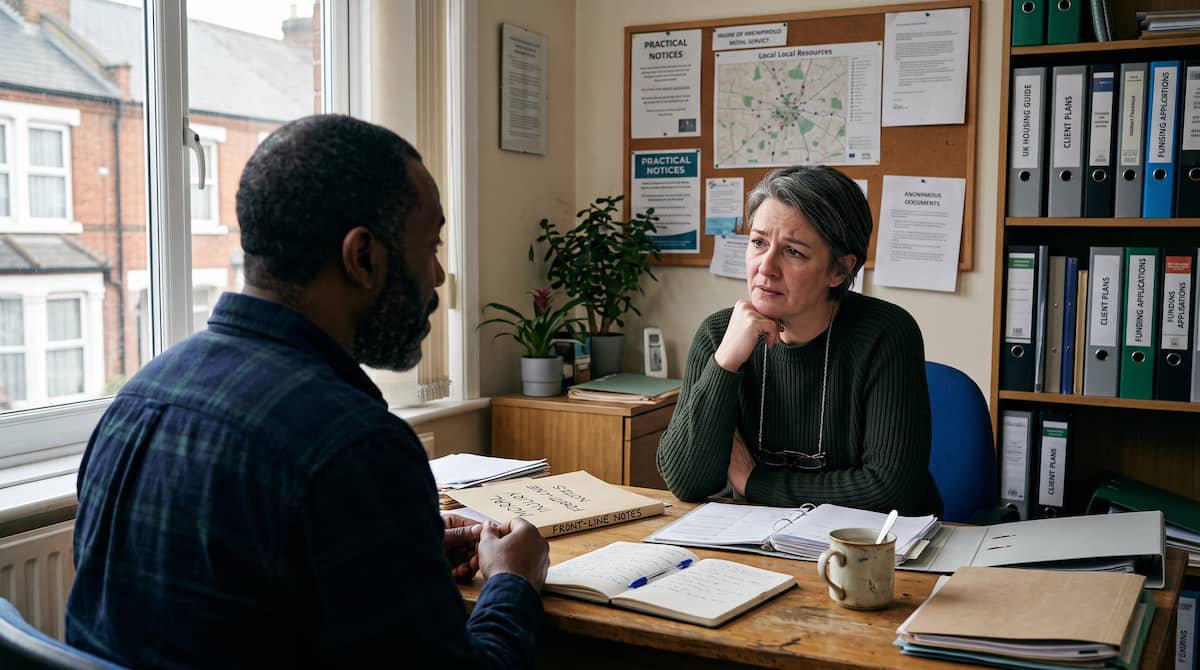

Supervision is supposed to create space for professional support, development, accountability and reflection.
But what happens when the supervision meeting becomes another place to discuss targets?
Another caseload review.
Another risk register.
Another set of overdue actions.
Another performance conversation.
Another opportunity to check whether the case notes have been completed.
All of those things can matter.
But if supervision becomes dominated by them, something important can disappear.
The person doing the work.
Homelessness workers may be supporting people experiencing trauma, mental distress, substance use, safeguarding concerns, exploitation, poverty and repeated housing instability.
They may be making difficult decisions with incomplete information.
They may be exposed to aggression, distress and repeated crisis.
They may also spend significant amounts of time trying to secure outcomes that simply are not available.
That requires more than case monitoring.
It requires space to think.
What is supervision in homelessness services?
Supervision is a structured process through which managers and practitioners review work, responsibilities, professional development and support needs.
The precise model varies between organisations.
For some services, supervision is primarily managerial.
For others, it may incorporate clinical or professional supervision.
Some organisations also provide dedicated reflective supervision or reflective practice.
These approaches overlap, but they are not interchangeable.
A useful starting point is to ask:
What is this supervision session actually designed to achieve?
If the answer is mainly:
- checking targets
- reviewing caseloads
- monitoring performance
- updating risk
- allocating actions
- checking compliance
then there may be little space left for reflection.
The problem is not that those activities are unnecessary.
The problem is when they become the entire conversation.
Managerial supervision
Managerial supervision usually focuses on the relationship between the employee and the organisation.
It may cover:
- workload
- caseload
- performance
- attendance
- objectives
- policies
- targets
- professional responsibilities
- training
- organisational priorities
- safeguarding responsibilities
- operational issues
This is an important function.
Managers need to know whether work is being completed safely and effectively.
Practitioners also need clarity about expectations.
Managerial supervision provides a structure for that accountability.
But managerial supervision alone may not provide enough space to explore the experience of doing emotionally demanding work.
Clinical or professional supervision
Clinical or professional supervision is usually more focused on the practitioner’s professional reasoning, interventions and specialist practice.
The exact meaning will depend on the profession and service.
In some settings, supervision may involve clinical formulation, therapeutic practice or specialist decision-making.
In homelessness services, it may instead focus on professional practice, complex cases, safeguarding, risk and the application of particular frameworks.
Not every homelessness worker requires clinical supervision in the same form as a clinical professional.
But many workers do need somewhere to explore the professional complexity of their role.
Reflective supervision
Reflective supervision places particular emphasis on how practitioners think about their work.
It may explore:
- assumptions
- emotional responses
- relationships
- professional boundaries
- decision-making
- uncertainty
- power
- communication
- patterns of behaviour
- what may have been missed
- what can be learned
This overlaps with reflective practice.
The distinction is partly about context.
Reflective practice can happen individually, between peers or through facilitated group sessions.
Reflective supervision usually takes place within a supervision relationship.
The important point is that both create a different kind of space from straightforward case monitoring.
When supervision becomes a case review
Imagine a monthly supervision meeting.
The manager asks:
How many open cases do you have?
How many have moved on?
Which cases are overdue?
Are all risk assessments completed?
What safeguarding referrals are outstanding?
Have your support plans been updated?
What training have you completed?
Those questions may all be legitimate.
But imagine the entire meeting consists of them.
There is no discussion of how the worker is experiencing the work.
No exploration of a difficult case.
No opportunity to examine a professional judgement.
No space to discuss a relationship that has become challenging.
No conversation about whether repeated exposure to distress is affecting the worker.
No opportunity to consider what the team is learning.
The supervision meeting has become a monitoring mechanism.
That distinction matters.
What gets lost when reflection disappears?
When supervision becomes dominated by targets and case management, practitioners may still be receiving supervision on paper.
But the function of supervision has changed.
The worker may become accustomed to preparing for supervision by gathering numbers rather than thinking about practice.
The manager may become accustomed to asking whether actions have been completed rather than asking what the practitioner is noticing.
Difficult experiences may remain unspoken because there is no obvious space for them.
Over time, this can contribute to a culture where workers are expected to manage difficult situations privately and then return with an updated spreadsheet.
That is not necessarily a failure of individual managers.
Often it reflects the pressure placed on managers themselves.
If managers are overloaded, they may have very little time to prepare for meaningful supervision.
Supervision and staff wellbeing
Homeless Link specifically recommends regular supervision or one-to-one meetings that include space for reflection and wellbeing, rather than focusing only on performance or absence management.
That distinction is important because wellbeing is not simply a question of whether someone is "okay".
A meaningful wellbeing conversation might explore:
- What is becoming difficult?
- What is taking up most of your attention?
- Are you carrying something from work outside working hours?
- Is there anything affecting your ability to do the role?
- Are you getting enough recovery time?
- Are there situations you are finding particularly difficult?
- Is there support you need?
- Is there something about the work itself that needs to change?
These questions do not turn supervision into therapy.
They help managers understand the conditions in which someone is working.
Supervision and burnout
This matters because homelessness workers can experience sustained occupational pressure.
Workload, staffing shortages, repeated crisis and emotionally demanding situations can all contribute to strain.
Our article Why Are Homelessness Workers Burning Out? explores the wider organisational pressures that can contribute to burnout in homelessness services.
Supervision cannot fix an excessive workload.
A monthly meeting cannot compensate for chronic understaffing.
Nor should supervision become a place where an organisation asks an exhausted worker how they can become more resilient while leaving the underlying pressures untouched.
But supervision can help identify when pressures are becoming unsustainable.
It can also give managers an opportunity to ask:
Is this an individual difficulty, a team problem or an organisational problem?
Sometimes it is all three.
Supervision and reflective practice
Supervision and reflective practice can complement each other.
A supervision session might identify that a worker is repeatedly struggling with a particular type of case.
Reflective practice might then provide dedicated space to explore the underlying pattern with the worker or wider team.
Our article Why Reflective Practice Is Essential in Homelessness Services explores how structured reflection can support professional curiosity, boundaries, decision-making and learning.
The two should not be forced into the same format.
A manager should not have to turn every supervision session into a formal reflective practice group.
Equally, reflective practice should not become another name for a performance review.
Supervision and moral injury
Some homelessness workers face situations where they understand what would provide a safer or better outcome but cannot secure it.
There may be no suitable accommodation.
A service may have eligibility restrictions.
A referral pathway may be full.
Another agency may be unable to respond.
The worker may still be responsible for communicating the outcome.
These situations can create significant ethical pressure.
Our article on moral injury in frontline homelessness work explores the tension between professional responsibility and what practitioners can actually control.
Supervision provides one place where that tension can be acknowledged.
The question is not simply:
What should the worker have done?
It may also be:
What was actually possible?
What responsibility belonged to the worker?
What belonged to the wider system?
What can the organisation learn?
Supervision and retention
Good supervision can also contribute to a working environment where people feel supported and able to develop.
That matters for retention.
People do not necessarily leave homelessness services because they dislike the work.
Some leave because the conditions under which they are expected to do the work become difficult to sustain.
Our article Why Good People Leave Homelessness Services, and What Organisations Can Do About It explores the wider factors affecting staff retention.
Supervision will not solve pay, workload or progression.
But it is one of the everyday ways an organisation demonstrates whether professional support is actually part of the job.
A practical supervision framework for managers
Managers can use a simple framework to review whether supervision is doing enough.
1. ACCOUNTABILITY
Are we covering the essential managerial responsibilities?
Consider:
- workload
- caseload
- performance
- safeguarding
- risk
- actions
- professional standards
- organisational responsibilities
If these areas are never discussed, supervision may lack necessary accountability.
But they should not automatically consume the whole meeting.
2. PRACTICE
Are we talking about how the work is being done?
Ask:
- What are you noticing?
- What is proving difficult?
- Are there recurring patterns?
- What assumptions might be influencing decisions?
- Are there situations where professional curiosity is needed?
- Is there anything the practitioner is uncertain about?
3. IMPACT
What is the work doing to the practitioner?
Ask:
- What has stayed with you?
- Are there particular cases you are finding difficult?
- Are you carrying work outside your normal hours?
- Have you noticed changes in your energy or engagement?
- Are you becoming more detached or reactive?
This is not diagnosis.
It is noticing.
4. DEVELOPMENT
What is the practitioner learning?
Consider:
- skills
- knowledge
- confidence
- professional judgement
- training
- career development
- areas for further support
5. ORGANISATION
What does the supervision conversation tell you about the service?
Look for recurring themes.
Are several staff struggling with the same issue?
Are the same referrals repeatedly causing problems?
Are workers regularly reporting that a particular pathway is unavailable?
Are staff spending excessive time on administration?
Are managers repeatedly hearing the same concerns?
Those patterns may point beyond individual performance.
A supervision review checklist
Managers can ask themselves:
Purpose
- Is the purpose of supervision clear?
- Does the practitioner understand what the session is for?
Balance
- How much time is spent on cases and targets?
- How much time is available for practice and reflection?
- Is wellbeing discussed meaningfully?
Safety
- Can staff raise concerns without fearing that everything will become a performance issue?
- Is there appropriate confidentiality and clarity about its limits?
Development
- Is supervision helping people develop?
- Are learning needs identified?
- Is professional curiosity encouraged?
Organisational learning
- Are recurring themes being identified?
- Do supervision conversations reveal problems that need organisational action?
Management support
- Does the manager have enough time and support to provide good supervision?
- Is the manager themselves receiving supervision or reflective support?
If the answer to several of these questions is no, the issue may not be that individual supervisors need another template.
The supervision model itself may need reviewing.
What good supervision should feel like
There is no single correct emotional experience of supervision.
It should not necessarily feel comfortable.
Good supervision may involve challenge.
A manager may question a decision.
A practitioner may need to reconsider an assumption.
A safeguarding concern may need to be escalated.
A boundary may need to be strengthened.
But the conversation should be purposeful.
Staff should leave with greater clarity rather than simply a longer list of tasks.
They should understand what needs to happen.
They should know where responsibility sits.
They should have had some opportunity to think about their practice.
And they should know where to go if the situation becomes more difficult.
What managers need too
It is easy to focus on supervision for frontline practitioners and overlook managers.
But managers may be carrying:
- staff concerns
- performance issues
- safeguarding decisions
- organisational pressure
- staffing shortages
- difficult incidents
- complaints
- service-user concerns
- senior leadership expectations
That is why manager capability matters.
The wider article Housing Is Under Pressure: Are We Equipping Managers to Lead Through It? explores how workload, control, support, role and organisational pressure can affect managers and teams.
Managers need somewhere to think too.
Supervision is part of workforce development
Supervision should not be treated as an administrative requirement that sits alongside workforce development.
It is one of the mechanisms through which workforce development happens.
Training introduces knowledge.
Supervision helps practitioners apply it.
Reflective practice helps them examine it.
Experience tests it.
Organisational learning develops it.
That is why homelessness workforce development needs to include the structures surrounding practitioners, not simply the courses they attend.
A final question for managers
The most useful question may not be:
"Are we completing supervision?"
It may be:
"What is supervision actually doing for our staff and our service?"
If supervision helps practitioners think, develop, raise concerns, understand responsibility and feel appropriately supported, it is doing important work.
If it has become primarily a mechanism for checking targets and updating cases, it may be time to reconsider the balance.
Supervision should hold accountability.
But accountability is not the same as monitoring.
Good supervision creates space for both.
How Reflect can support supervision and reflective practice
Reflect Training & Consultancy provides facilitated reflective practice, specialist workforce development and organisational support for housing, homelessness and other teams working with complexity and emotionally demanding situations.
Support can include:
- facilitated reflective practice
- workforce development
- psychologically informed practice
- trauma-informed approaches
- professional boundaries
- safeguarding and risk
- leadership and management development
- learning from difficult incidents
The aim is not to replace good management.
It is to help organisations create the conditions in which managers and practitioners can think, learn and make better-informed decisions.
Explore Reflect's support for homelessness and housing teams.
Questions About Supervision in Homelessness Services: Are We Supporting Staff or Just Monitoring Cases?
Supervision in homelessness services is a structured process for reviewing professional practice, workload, risk, development, wellbeing and organisational responsibilities. Effective supervision should provide both accountability and appropriate space for practitioners to discuss difficult work, develop their judgement and identify support needs.